One of the quickest ways to make Japanese stick is to stop studying "Japan" and study one place: a single station, a single street, the story of why it looks the way it does. The same dozen words keep returning, and each comes attached to something you can picture. Fussa, a small city in western Tokyo, is an unusually good place to try it, because its history is written on its shop signs.
Mike runs Mike from Japan, a channel of long walking films about what its description calls "the real Japan, beyond tourism", seen through the eyes of a local who was born and raised there. He speaks English and walks neighbourhoods that visitors skip: a hidden Indian town in Tokyo, a drinking town in Koiwa, a ghost station near Narita Airport. This post is about the film he picked as the first one for new viewers, and in his words:
It's a good intro to the hidden, local side of Japan I cover, and I think your learners will enjoy it.
About one-third of the city is taken up by the US military base, Yokota Air Base. Because of that, Fussa has a strong American feel.
The first sentence is from his reply to us about this video; the second is a line he says in it.
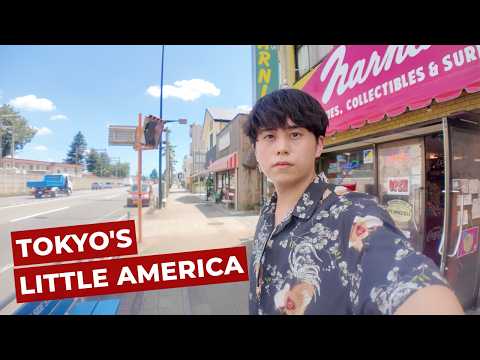
Start with this video
Mike from Japan
What the American town actually is
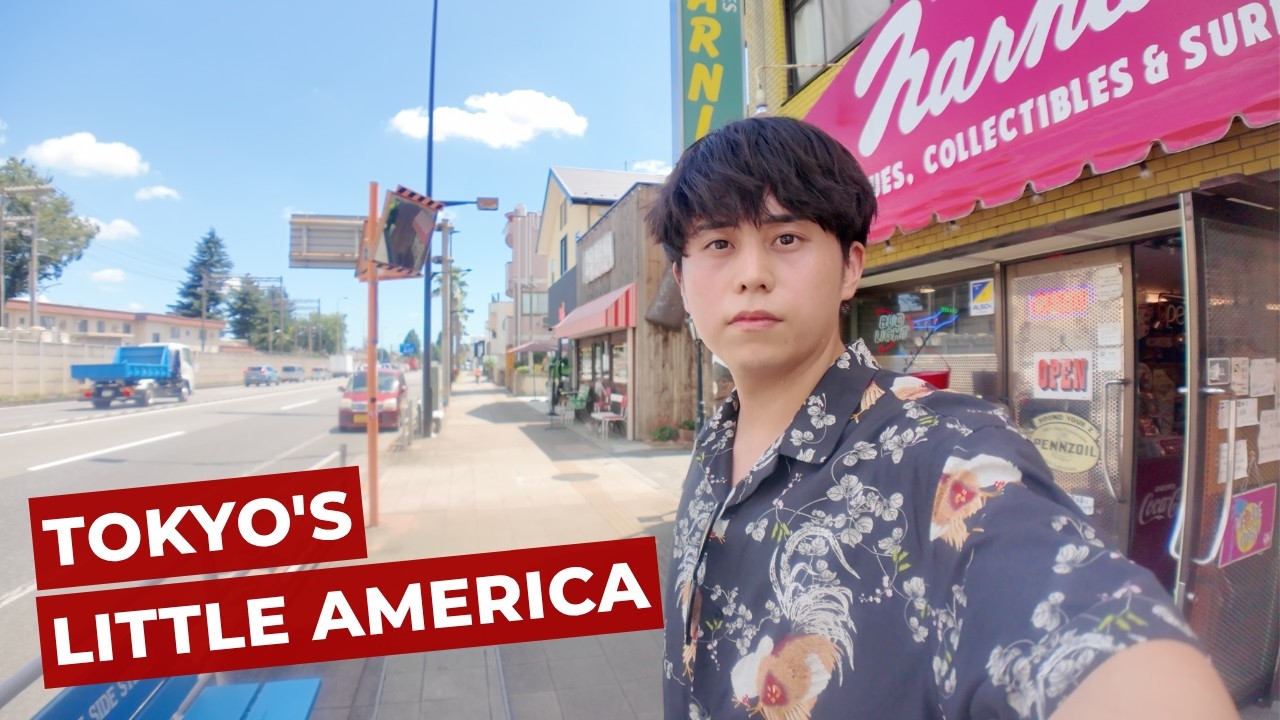
Mike's video is called "Tokyo's Hidden American Town Tourists Never See", and the town is 福生 (Fussa). According to Wikipedia's article on Fussa, the city covers about 10.16 square kilometres and about one third of it is occupied by the United States Air Force, at Yokota Air Base. The article on the base adds that the Imperial Japanese Army built the facility in 1940, that US forces moved in soon after Japan's surrender, and that today it hosts the 374th Airlift Wing and the headquarters of United States Forces Japan. The base is not entirely inside Fussa, since it spreads across parts of six cities.
You can see the result on the street. Mike starts near Ushihama Station and walks along the base fence to a strip of vintage shops, bagels, American diners and bars with English signs. He also points out what is not American: a Japanese language school, a Tanabata festival at Fussa Station, a very ordinary residential stretch. It is a film about a place where two languages share the signage, which is exactly why it works for learners.
Fussa even has a local snack built around that mix. The Fussa Dog has been offered in the city since 2011, uses sausages from two local makers, Otama Ham and Fussa Ham, and comes with size rules, the length tied to Route 16, the road by the base. Mike mentions the rules in the video.
Words you'll meet
This is an English-speech video, so treat it as culture first and listening practice second. These are the Japanese words for the things he points at, and they are the ones you will keep meeting in any film about a neighbourhood or a base town.
| Japanese | Reading | Meaning |
|---|---|---|
| 基地 | kichi | base, usually military: 横田基地, the Yokota base |
| 米軍 | beigun | the US military |
| 空軍 | kūgun | air force: 米空軍 is the US Air Force |
| 航空自衛隊 | kōkū jieitai | Air Self-Defense Force, which Mike notes also uses the base |
| 街 | machi | town, streets, a built-up area |
| 駅 | eki | station |
| 地元 | jimoto | local, one's home area |
| 名物 | meibutsu | local speciality, such as the Fussa Dog |
| 七夕 | tanabata | the star festival he happens on at Fussa Station |
All of these appear in the Japanese auto-generated subtitle track YouTube offers for the video. That track is machine output and noisy, so use it for vocabulary and not as polished text. 街 is a good one to hold on to: it is the word for a town as a living place, and you will see it in compounds like 街並み (machinami, a streetscape) on every neighbourhood walk.
Try it tonight
Ten minutes. Watch Mike's walk down the base-side street with the sound on, and each time a sign fills the frame, pause and say aloud which Japanese word from the table the English sign is standing in for (the base, the station, the local speciality). Then open the Japanese Wikipedia page for 福生市 and read only the first sentence, using the table to get the outline. Write down three new words from it and bring them to the next video. Our guide to choosing manageable Japanese video explains why a visual walk like this suits your level, and everyday life in Japan on YouTube lists more places to start. If you watch it in Glosaire, you can tap each word as it comes up.
More from the channel
The channel's most watched film is Tokyo's Hidden Indian Town (Not For Tourists), and there is The Roughest Drinking Town Tourists Never See (Koiwa) for a different kind of neighbourhood. We first praised The Tokyo Building That Came Back From the Dead, a recent upload. If a quieter side of Japan appeals, we also wrote about quiet places in Japan.
Follow Mike from Japan on YouTube for new walks through the local side of Japan.