A lot of people come to Japanese through a game, and a game is a surprisingly good place to learn it from. The screen shows you what a sentence is about before you have read it: a character hands you a shovel, a sign stands outside a shop, a map opens. You rarely need a dictionary to get the gist, which is the one thing a beginner needs most and gets least.
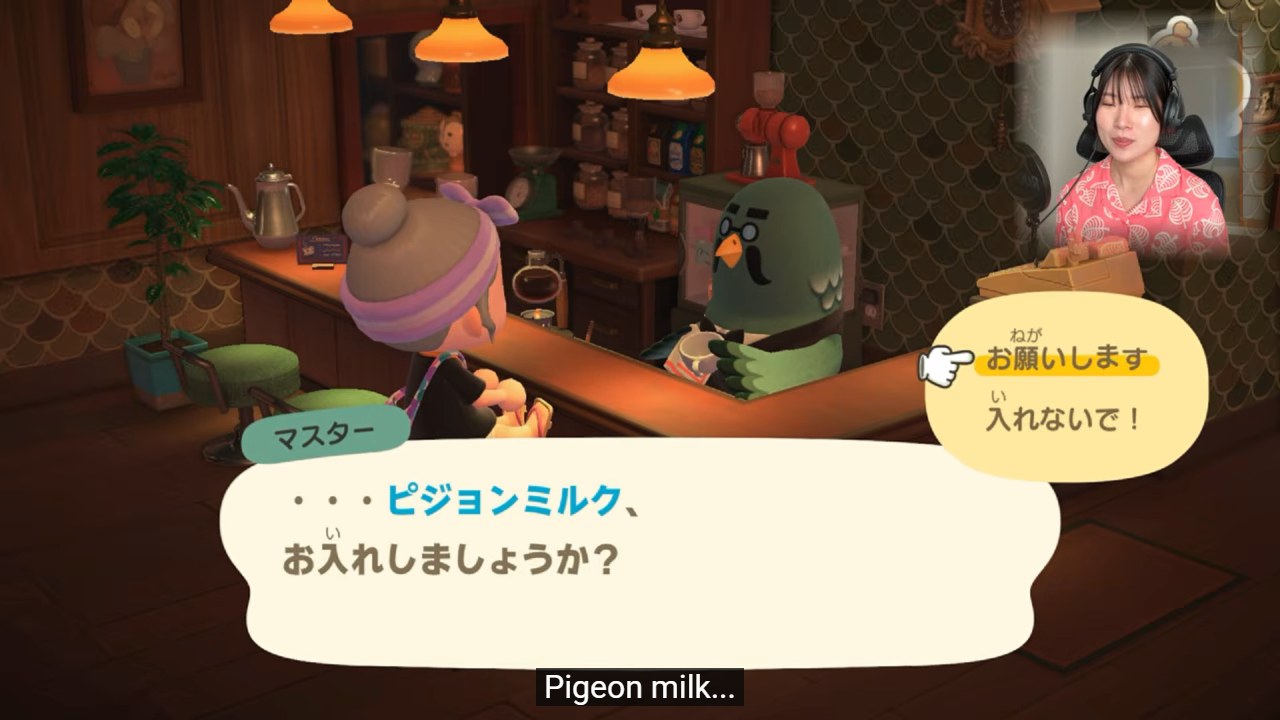
Yuna Satou takes that idea literally. On her channel, Satou's Nihongo Playground, she plays Animal Crossing and other games while narrating in plain, clear Japanese, alongside a long series of beginner lessons and the hiragana and katakana mnemonics most of her viewers arrive through. She adjusts her speed from video to video and aims for a style between textbook Japanese and the real thing: not slowed down or unnatural, but clearer and easier to follow than a conversation in the street. She is a qualified Japanese teacher and a learning consultant, and when we asked her what she would tell a total beginner before they start watching Japanese, her answer came in two moves.
We naturally pick up Japanese through listening, reading, and using it in everyday life, not by memorizing grammar rules. Immerse yourself in Japanese and imitate what native speakers say!
Not sure what to imitate? Japanese has many different speaking styles, so I make videos using natural, gender-neutral Japanese that anyone can confidently imitate and use in real conversations.
Immerse, then imitate. The two halves are worth taking one at a time, because the second is the one most of us skip.
First move: immerse in Japanese you can mostly follow
Immersion gets described as if it meant drowning, hours of native speech you cannot parse, and that is where the method gets its reputation for failing. The version Yuna is describing is older and more precise. Stephen Krashen's input hypothesis, from 1982, says we acquire language by understanding messages that sit just past what we already know. Not far past. Just past. A game narrated by a teacher who knows what you know is almost a laboratory version of that: the picture carries most of the meaning, and her sentence adds one new piece on top.
That is also why starting with a game you already understand matters. If you have played Animal Crossing in English, you know what the museum is for and what the shop sells, so when the Japanese arrives you are matching words to things you already understand rather than decoding from zero. We have a longer piece on choosing video you can actually learn from, and the short version is her video.
Second move: say it back
This is the half that is easy to skip. Listening a lot builds understanding, and understanding alone does not become speech, which is the gap we have written about before. Yuna's answer to it is imitation, and the research gives that a name: shadowing, repeating what a speaker says a beat behind them, out loud. A 2018 review of the shadowing studies by Yo Hamada notes that the technique has helped lower-proficiency listeners most of all, which is exactly the group she is talking to. The reason, as far as anyone can tell, is that saying a line forces you to hear every sound in it, including the ones you were quietly skipping.
In practice it is small. Play a sentence, pause, say it back, and try to match her rhythm rather than her words. Three sentences a session is plenty at the start. If reading Japanese comes easier to you than hearing it, this is also the fastest fix we know.
What you imitate matters
Her second quote is the part I had never heard a teacher say out loud. Japanese has many ways of speaking, and a lot of what reaches learners through anime and drama is written to signal character: rough, strongly masculine, strongly feminine, old-fashioned. Linguists call this role language, and it is real enough to measure. Mie Hiramoto's study of Cowboy Bebop counted the gendered expressions in the characters' speech and found them doing deliberate work in building who those characters are. Copy them word for word and, in a real conversation, you are playing a character.
Yuna's videos are made in neutral, standard Japanese on purpose, the kind anyone can say back without sounding like someone they are not, and when a game character talks in an unusual way she stops to point it out. That makes her channel unusually safe to imitate, which is the whole point of the second move.
She adds one more thing: grammar study is helpful too, as a support for immersion rather than a replacement for it. Watch first, then look up the pattern you keep hearing. It sticks better in that order.
Start here: a walk around an Animal Crossing island

Start with this video
Satou's Nihongo Playground
A good place to begin is Part 2 of her Comprehensible Japanese with Animal Crossing: New Horizons series, about twelve minutes long. The series begins with Part 1, so start there if you want the whole story from the first island morning, and Part 2 is the one we use below. She walks her island and narrates in simple, clear Japanese, and because you can see everything she mentions, the pictures carry the meaning: she says "this is a park" while the park is on screen, then moves on to a ramen shop, a hot spring, an amusement park, a museum and a cafe.
What makes it a good first video is how much it repeats. Many places get the same short pattern, such as ここは遊園地です (here is the amusement park) and ~がたくさんあります (there are many of them), so the sentences come round again and are easy to say back. She also stops to explain small things as she goes, such as when Japanese speakers say 喫茶店 and when they say カフェ. At the end she mentions that she normally plays the game in English and switched to Japanese for this recording, and suggests that anyone who owns it try the same.
Words you'll hear
- 公園 (kōen): a park, which is where she starts the tour.
- 遊園地 (yūenchi): an amusement park, introduced as 楽しい遊園地, a fun amusement park.
- 温泉 (onsen): a hot spring, and she points out that the sign for it hangs on the curtain at the entrance.
- 博物館 (hakubutsukan): a museum, home to the fossils and the insect area.
- 喫茶店 (kissaten): a coffee shop, which she says usually suggests an old-fashioned, nostalgic style, while カフェ (kafe) suggests a more modern one.
- 化石 (kaseki): a fossil, said again and again in the museum.
- 感謝 (kansha): gratitude, glossed by her as the feeling of ありがとう.
Try it tonight
Ten minutes is enough. Watch the first three minutes of the video once, straight through. Rewind and play it again, and this time pause after ここは公園です and the next two places she names, and say each one back. Then put the video down and do the same for the room you are sitting in: ここは部屋です, and whatever you can see that has many of something, ~がたくさんあります. That is immersion and imitation in one sitting, and it is more Japanese than most people say in a week of study.
More from the channel
If you are brand new, Hiragana with Mnemonics is the video most people arrive through, and Katakana with Mnemonics follows it. Her Basic Japanese for Beginners series begins with Lesson 0 on the characteristics of Japanese and Lesson 1 on greetings and the first hiragana, and it now runs past Lesson 39. When you want more of the same listening practice as the video above, Part 1 of the Animal Crossing series is a longer walk through her island and her house.
Yuna holds a Postgraduate Diploma in Teaching Japanese as a Foreign Language, has taught for more than eight years, and has worked as a learning consultant for over a hundred learners. If you want her guidance one to one, she takes learners through her site, which offers structured self-study support. If you watch her videos in Glosaire, you can tap the words as they come up.
Follow Satou's Nihongo Playground on YouTube for more clear, copyable Japanese.