Most beginner Japanese is learned for a trip, and most trips are fine until something small goes wrong: the train stops, a venue asks for money you did not expect, a label says something you cannot read. Those are the moments when a handful of ready-made sentences is worth more than a page of grammar rules, and they are exactly what the video in this post is built from.
Tokyo Slow Japanese is a channel of slow, standard Tokyo Japanese for beginners and JLPT N5 students, set over anime-style Tokyo scenery, with Japanese, romaji and English subtitles on screen. It has about 22,000 subscribers and 55 uploads, and its own description says the goal is to be the "World's easiest Japanese textbook" on YouTube. Each conversation video is a run of short two-person dialogues, which makes them easy to rewatch one scene at a time.
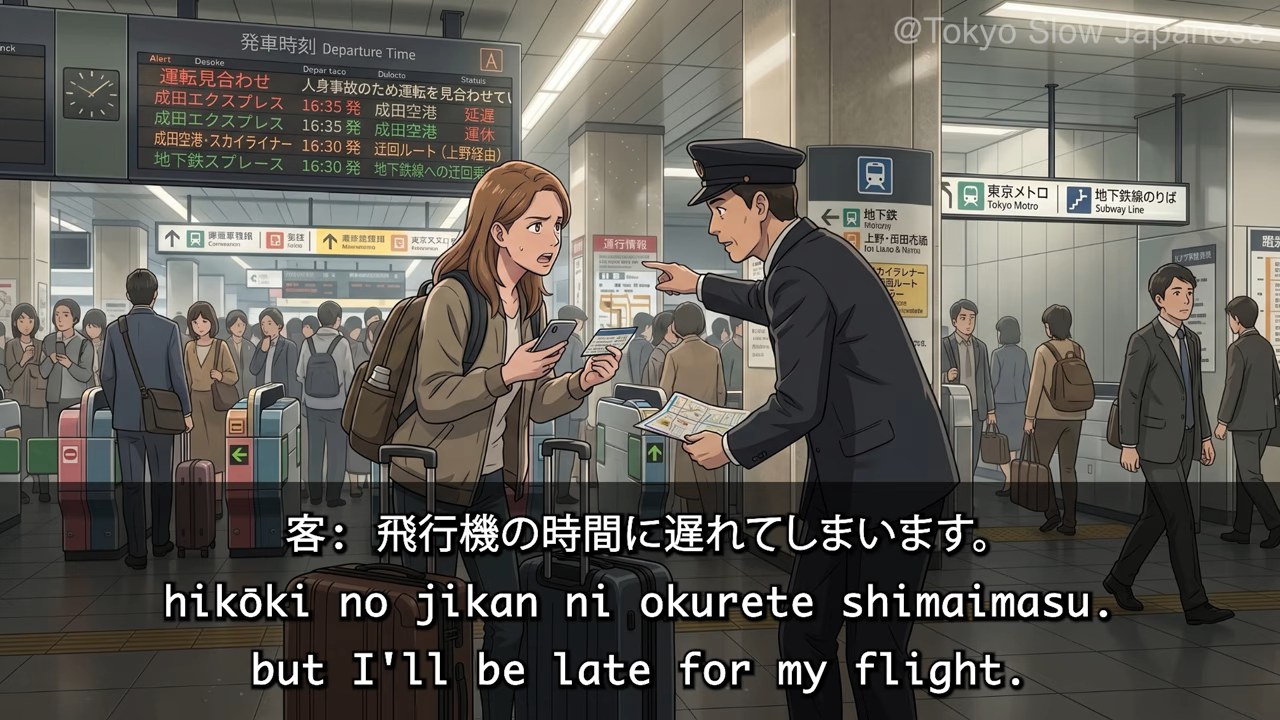
事故ですべての電車が止まっています。
成田空港に行きたいんですが、飛行機の時間に遅れてしまいます。
The first line is the station clerk, the second is the passenger. Between them they contain most of what you would need on a bad travel day, and the second sentence carries one of the two grammar points the video itself flags.
Why memorised chunks help you speak
Learners often assume that speaking means building each sentence from parts. A small study by Boers and colleagues, published in Language Teaching Research in 2006, suggests that ready-made phrases do a lot of the work. Thirty-two college students of English listened to and read authentic material for 22 teaching hours, and half of them were also taught to notice standardised word combinations. Two blind judges later rated that half as more proficient in an interview, and the number of such phrases in each interview tracked the ratings. It is a small experiment on English learners, so I read it as a good reason to try the approach rather than a promise.
A scripted dialogue is a tidy way to collect those chunks. If you have been struggling with the gap between understanding and speaking, repeating whole lines from a dialogue that someone has written for you is a gentle place to begin.
The two patterns worth pulling out
The first is 〜てしまいます. In 遅れてしまいます (okurete shimaimasu), the passenger is saying "I will end up late", with the sense of an outcome nobody wanted. The video lists it as an N4 pattern, and it suits a station, where all the news is unwelcome.
The second is 〜てもいいですか (te mo ii desu ka), "may I ...?". In the live house scene the visitor asks 写真を撮ってもいいですか (shashin o totte mo ii desu ka), may I take photos, and the staff answer that photos and video are prohibited. The video lists this one as N5.
There is also a pattern I would add myself, which is how the clerk offers an alternative: お急ぎでしたら別のルートをご案内します, if you are in a hurry I will guide you to another route. The passenger then asks for directions and gets a short chain of instructions (take the subway to Ueno, then board a limited express), which you can follow slowly because each step is its own sentence.
Words from the five scenes
| Japanese | Reading | Meaning |
|---|---|---|
| 別のルート | betsu no rūto | another route |
| 地下鉄 | chikatetsu | subway |
| ドリンク代 | dorinku-dai | drink fee |
| 禁止 | kinshi | prohibited |
| 賞味期限 | shōmikigen | expiration date (best before) |
| 国際免許 | kokusai menkyo | international driving licence |
| 下着 | shitagi | underwear |
| インナー | innā | innerwear |
Start here: all five scenes, eight minutes

Start with this video
Tokyo Slow Japanese
Stopped Train in Japan!? 5 Travel & Daily Life Scenes runs 8 minutes 20 seconds and was published on 16 October 2026. The chapters are buying winter innerwear, asking for another train route, entering a live house, checking an expiration date at a shop, and renting a car. The description says difficult kanji are shown as hiragana to keep things light for beginners. If you are unsure how to judge whether a video suits your level, our guide to choosing a manageable Japanese video covers it, and this one fits the description of slow, clear and short.
If you watch it in Glosaire, you can tap each word as it comes up.
The channel sells PDF scripts and MP3s of its dialogues through YouTube membership and Patreon, if you would like the text to work from.
Try it tonight
Take ten minutes with the station scene, from 1:58 to 3:42. The description recommends three passes, and they work well together.
- Watch once and read the Japanese subtitles.
- Watch again with your eyes closed and listen to the sounds.
- Shadow the passenger, speaking aloud right after the voice: 成田空港に行きたいんですが、飛行機の時間に遅れてしまいます。 then 地下鉄の駅はどこですか? then 分かりました。急いで行ってみます。助かりました。
If reading comes more easily than hearing for you, the second pass is where you will notice the difference, and this piece on reading versus listening explains why.
More from the channel
The most-watched upload is a 20-minute slow listening compilation for N5 beginners. The same scene format returns in Shinkansen Luggage in Japan!? and Capsule Hotel in Japan!?. For the grammar from the live house scene on its own, there is Master Japanese Te-Form: May I ~? (〜てもいいですか?), with 25 essential verbs.
Follow Tokyo Slow Japanese on YouTube for more slow, subtitled conversations.