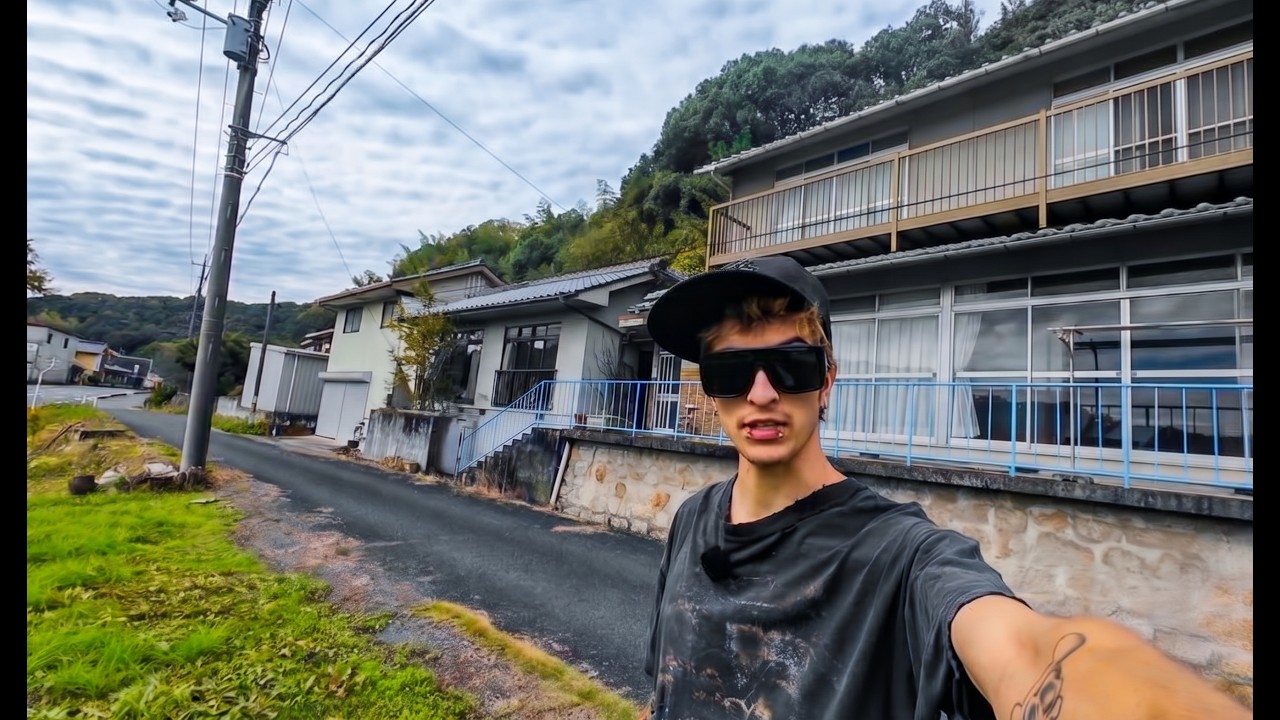
Plenty of people start learning Japanese because of a game, and then wonder whether the game itself can do any of the teaching. Patrick, who runs the channel Region Unlocked, thinks it can. His channel describes itself as a place to learn Japanese "by unlocking what was lost in translation, through games, conversations, and life in Japan", which in practice means retro game playthroughs in Japanese with the grammar, vocabulary and nuance explained as he goes, easy listening videos pitched at N5 to N3, and a series about hunting for retro games while living in Japan.
When we asked him how he would suggest someone learn Japanese through games, he gave us four points and a closing thought. The closing thought is the one to keep in mind while you read the rest.
The main bit of advice is to find a way to enjoy the process of studying Japanese, and for me that was games. Because it was fun to do, I was able to build a daily habit of studying without even feeling like intense studying. Games are a really overlooked, and fantastic, resource for learning Japanese!
Does learning from games actually work?
There is some evidence behind the idea, with a caveat. Liss Kerstin Sylvén and Pia Sundqvist studied 86 Swedish children aged 11 to 12 who were learning English, using a questionnaire, a language diary and three tests covering reading, listening and vocabulary. They found that English proficiency went along with how often the children gamed and which kinds of games they played (ReCALL, 2012). That is a correlation among young learners of English, so it cannot prove that games caused the gains. It does fit what Patrick describes: when the activity is enjoyable, people do more of it.
Four rules, in Patrick's order
First, pick the game before you pick the method. Patrick suggests a title you already know well, or one made for children, such as Pokémon. A familiar story means you can follow what is happening even when a sentence slips past you, and children's games tend to add furigana, the small kana printed above a kanji to show how it is read, so the kanji are far less of a wall. This is the same logic we describe in our piece on choosing video you can actually follow.
Second, make lookups nearly free. He names three kinds of tool: a popup dictionary (any will do), an online game script, and OCR software such as Yomininja. A popup dictionary shows a word's meaning when you hover over it. A game script is a text copy of the game's dialogue, often posted by fans, which lets you read a line at your own pace instead of before the box disappears. OCR reads the text off your screen so you can feed it to the dictionary. The point of all three is that checking a word should cost seconds, so the game keeps moving.
Third, consistency beats perfection. Patrick's advice is to enjoy the game every day and let that build the habit, rather than relying only on flashcards. Twenty relaxed minutes you actually do will add up faster than a perfect plan you abandon, and a game is one of the few study activities people open voluntarily.
Fourth, expect the discomfort. Early on you will not understand every word, and Patrick says to accept that. It is the ordinary state of reading something written for native speakers, and the answer is to keep going rather than to wait until you feel ready. Yuna Satou makes a related case for starting with Japanese you can mostly follow in our post on immersing and imitating with Animal Crossing. For another game played in Japanese, see Norki's Super Mario 64 series.
Start here: Mother 3, with every line explained

Start with this video
Region Unlocked
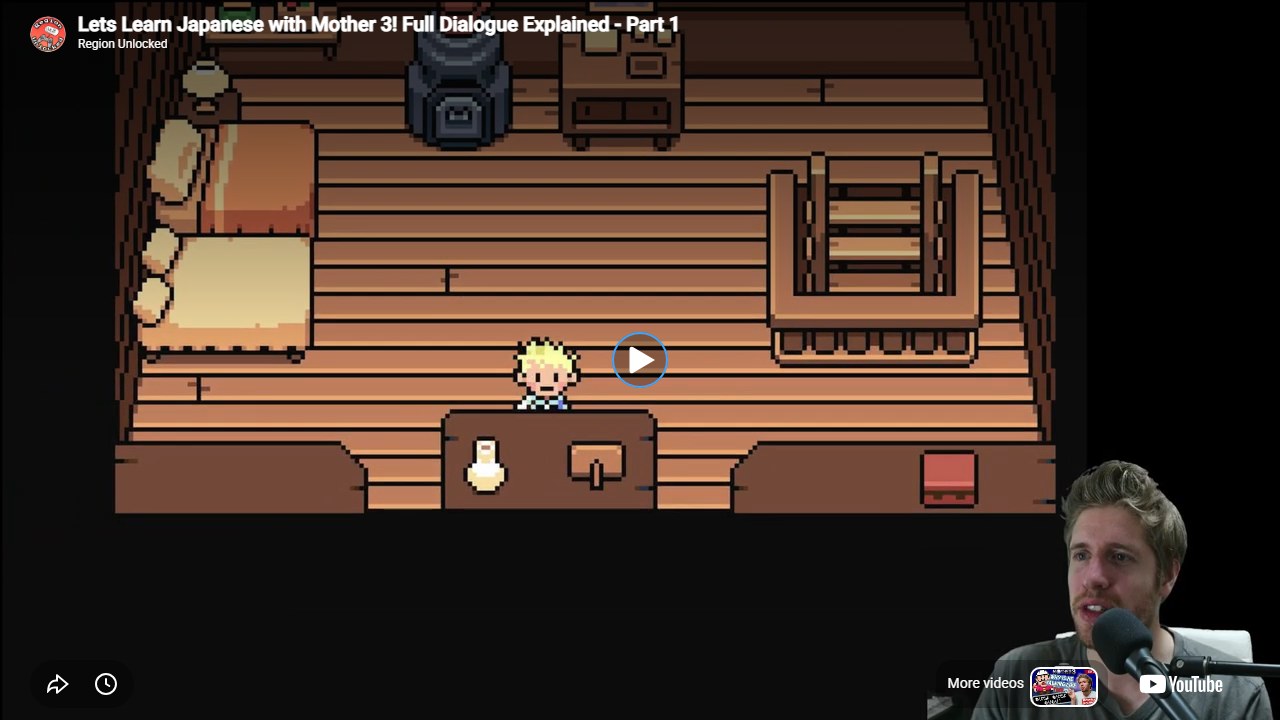
A good first video is Part 1 of his Mother 3 series, "Lets Learn Japanese with Mother 3! Full Dialogue Explained". It is a full playthrough of the game in Japanese in which he breaks down the real in-game dialogue, explaining grammar, vocabulary and nuance so you can follow what is said whatever your level. In effect he does the lookups for you on screen, which makes it a gentle way to see his second rule in action before you set up tools of your own.
It runs for about an hour and a half, which suits the point about consistency: play a stretch, stop, come back tomorrow. Part 2 and Part 3 are there when you want more, and he also has versions where he plays the game in Japanese without the line-by-line breakdown. If you watch it in Glosaire, you can tap the words as they come up.
Words you'll meet
| Japanese | Reading | Meaning |
|---|---|---|
| 漢字 | kanji | the Chinese-origin characters, which furigana help you read |
| ふりがな | furigana | small kana printed beside a kanji to show its reading |
| 辞書 | jisho | dictionary, the thing a popup tool gives you |
| 翻訳 | honyaku | translation, as in "lost in translation" |
| 会話 | kaiwa | conversation, one of the things the channel covers |
| 習慣 | shūkan | habit, the thing games helped Patrick build |
Try it tonight
Ten minutes will do. Open the first part of the Mother 3 video and watch until a character speaks a line. Pause, and try to say or write the line before he explains it. Then play his explanation and notice the one word or piece of grammar you missed. Write that word down with its meaning, stop there, and do the same tomorrow with the next line. That small, repeated loop is Patrick's third rule in action.
More from the channel
His most-watched video, No, Japanese Isn't Easy (and that's ok), covers his five years of self-study and has a section on games, so it is the longer version of the fourth point. For a different retro classic there is a Chrono Trigger series that begins at the Millennial Fair. For gentle listening practice, the Japanese Podcast for Beginners episodes are short and tagged N5 to N4, and Retro Game Hunting in Japan's FAR NORTH follows him to Hokkaido in search of Super Famicom games.
Follow Region Unlocked on YouTube for more game playthroughs, listening practice and life in Japan.