Food videos are some of the friendliest Japanese listening there is, and the reason is the kind of talking they contain. People who are eating don't give speeches, they react, in short sentences that come round again and again: 美味しい (oishii), 辛い (karai), 全然違う (zenzen chigau). Reaction language is also casual language, the sort a textbook tends to arrive at late, and here the food is right there on screen to explain it.
Durian Life is a Japanese family living in Malaysia, and their channel is built around that kind of listening. In their own words they share the real local life you won't find in any guidebook, from hidden street food stalls to secret local spots, and the videos are mostly the family sitting down to eat something Malaysian and talking about it in relaxed, everyday Japanese. Fumi, who appears on the channel as Durian Life's Daddy, is part of the family on screen, and the fourteen-year-old daughter is one of the stars, since several titles promise her honest reaction.
Start here: fish head curry, and the Malay versus Indian question
Fumi agreed to this post, and to this video as the place to begin. It is called "Malaysian Curry, DANGEROUSLY Next Level", and the description tells you what is going on: Malaysian fish head curry, the spiciness, the heat and the free-flow curry, which the family says they were not ready for.

Hover, focus, or tap a subtitle word for its contextual meaning.
Malay-style and Indian-style curry are completely different, aren't they. と here means "compared with": the curry is different from Indian-style curry. さ is a casual pause, and ね at the end asks for agreement.

Start with this video
Durian Life
The video is chaptered, which makes it easy to use. They head to the restaurant, order, and dig in, and then at 6:50 comes the honest opinion of the fourteen-year-old, followed by Daddy's meal time. Later there is a short explanation of "kaedama" (the Japanese word for a refill portion), and at 14:35 a comparison of Malaysian curry and Indian curry.
That comparison is where one line comes from, and it packs a lot of casual Japanese into a few beats.
マレー系とさ、インド系のカレーと全然違うね
Roughly, "Malay-style and Indian-style curry are completely different, aren't they". Two small things make it sound like a person rather than a page. The さ after マレー系 is a casual pause, a beat while the speaker sets up the comparison, and the ね at the end asks the listener to agree. Neither changes the meaning much, and both are what you hear across a table. We look at the same register from another side in our piece on tsundere, yandere and burikko, and the family-at-the-table feel is close to what we describe in everyday life in Japan on YouTube.
全然 does not need a negative
Many learners are told that 全然 must be followed by a negative, so 全然違う feels like a mistake. It isn't. Jiyeon Park's corpus study of zenzen, published in the Russian Journal of Linguistics in 2024, follows 2,154 examples from six corpora and reports that affirmative and negative uses both existed when the word first entered Japanese, that negative uses came to dominate from about 1940, and that the pragmatic uses she studies are more frequent in spoken corpora than written ones. Her conclusion is that in contemporary Japanese 全然 can carry a sense of completeness and reassurance aimed at the listener. That fits the line above: 全然 here just means "completely", and the speaker is inviting you to agree.
A fair summary for a learner is that the negative pairing is the textbook default, the affirmative use is real in casual speech, and a positive 全然 is something to recognise rather than to overuse in a formal email.
A line no textbook will teach you
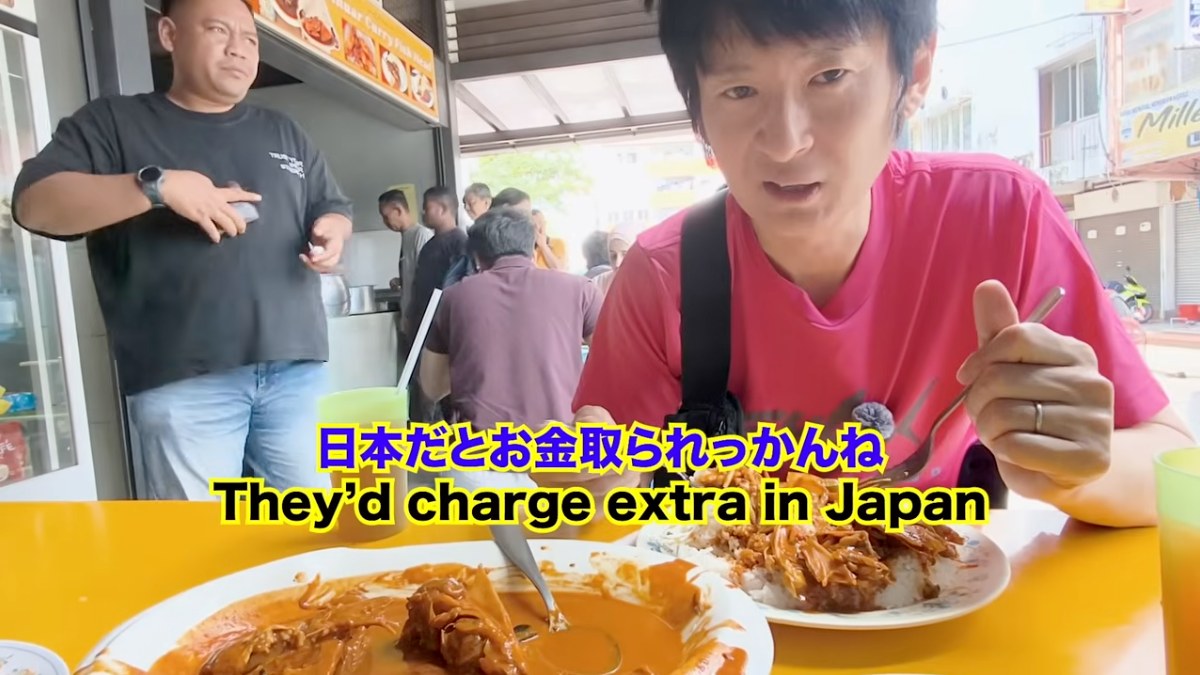
日本だとお金取られっかんね
Fumi says this at the curry stall, and the family's own subtitle gives it as "They'd charge extra in Japan", meaning something that comes free here would cost you back home. 取られっかんね is 取られるからね squeezed together in casual speech: 取られる is to be charged or to have something taken, から means because, and ね asks the listener to agree. Fumi himself pointed to this line as one that foreign learners almost never meet, since it lives in relaxed family talk rather than in textbooks. Recognise it when you hear it, but do not copy it in polite settings.
Words you'll hear
| Japanese | Reading | Meaning |
|---|---|---|
| マレー系 | marēkei | Malay-style, of Malay origin (系 labels a type) |
| インド系 | indokei | Indian-style |
| カレー | karē | curry, used for Malaysian and Indian kinds alike |
| 全然 | zenzen | completely, totally; also "not at all" with a negative |
| 違う | chigau | to be different, or to be wrong |
| さ | sa | casual pause marker inside a sentence |
| ね | ne | sentence-final "isn't it?", inviting agreement |
| 取られる | torareru | to be charged, to have something taken (passive of 取る) |
| 替え玉 | kaedama | a refill portion, best known as extra noodles at ramen shops |
Try it tonight
Ten minutes is enough. Play the video from 14:35, where the curry comparison starts, and listen to it once straight through while watching the food. Then go back, pause on the sentence about the two kinds of curry, and say it out loud three times, copying the pause at さ and the lift at ね. Once that feels natural, make one of your own with the same frame: pick any two foods you know and say Aとさ、Bと全然違うね. If you watch it in Glosaire, you can tap each word as it comes up. Finish by jumping to 11:28 and listening for 替え玉 in the kaedama chapter.
More from the channel
If the curry video clicks, there is plenty more in the same spirit. The family tries Malaysia's most notorious curry, nasi ganja, goes on a highway adventure to find the mystery of Malaysian chicken rice, and puts the daughter up against Batu Pahat ikan bakar for her honest reaction to Malay food. Another has the fourteen-year-old teaching durian haters how to eat durian, which fits a channel named after the fruit. For a single speaker telling a story rather than a family at a table, our post on a podcast trip to Fukui is a good next listen.
Follow Durian Life on YouTube for more local Malaysian food, eaten and discussed by a Japanese family.