Telling the time is one of the first things a Japanese course teaches, and one of the slowest to feel natural, because a list of 一時, 二時, 三時 does not sound like anything. A daily routine fixes that. It is the same small set of words every day, so a few minutes of someone describing their morning gives you times, daily verbs and the polite ます form in a setting where each one means something.
Sakura sensei runs the channel Let's nihonGo!. She is a Japanese teacher who teaches online, and her N5 and N4 listening videos are simply her talking about her own life, slowly, with Japanese captions and illustrations to check against. Her morning routine video is the one I would hand to someone who has just learned the clock.
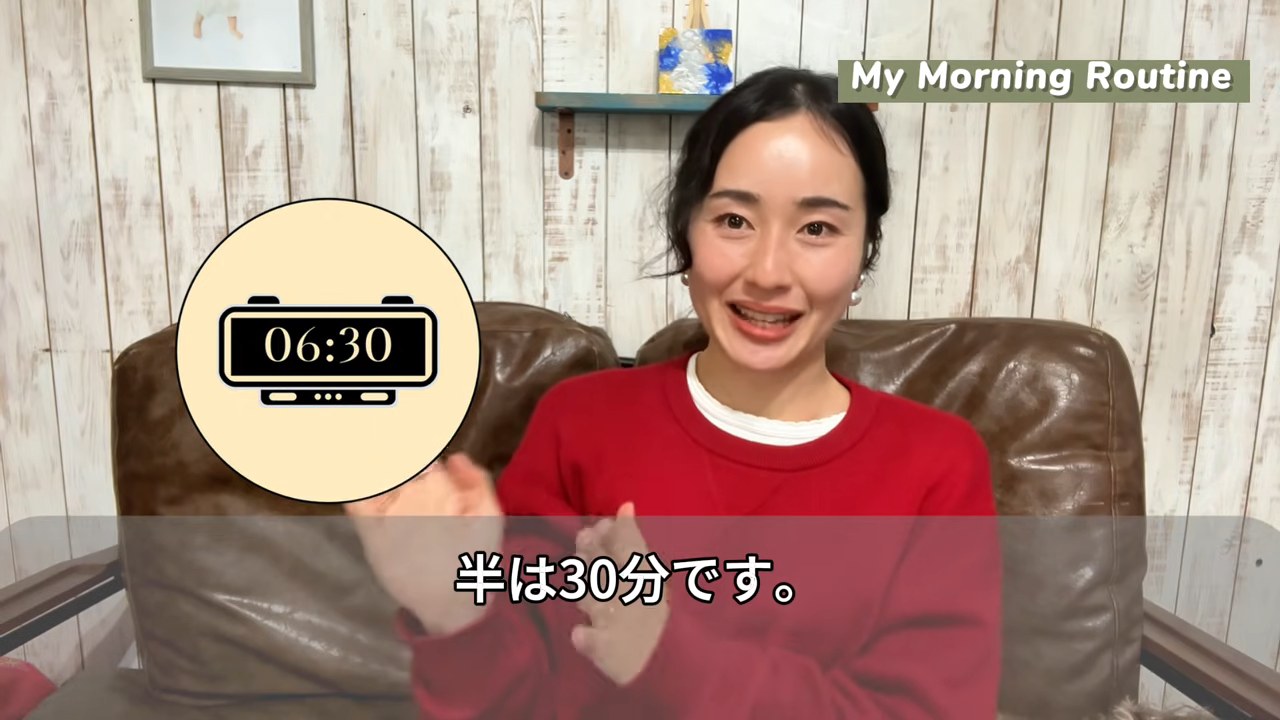
私は大体6時半に起きます。
半は30分です。
The first line means "I usually get up at half past six", and the second is her explaining the word 半 (half) before moving on. That is how the whole video works: one short sentence, then a plain explanation of the one piece that might trip you up.
Why a routine teaches times so well
Research on listening gives a reason to like this kind of material. In a 2011 ELT Journal article, Willy Renandya and Thomas Farrell make the case for extensive listening, meaning a lot of easy, enjoyable listening, for language learners, and the article takes its title from a complaint every learner knows: "Teacher, the tape is too fast!" Slow speech with short sentences is what removes that complaint, and repetition is what turns the practice into something you can feel improving. A morning routine has both built in, since the clock times, the verbs and the order of the day keep coming back.
If you are deciding what to watch next, how to choose manageable Japanese video is the longer version of this idea, and learning Japanese from YouTube lists where else to look.
Start here: a morning that begins at 6:30
The video is about ten minutes long, and the description splits it into waking up, breakfast, off to school and cleaning. We suggested it as the first one to try, and Sakura sensei agreed it is the right start. She gets up at about half past six. Her husband is an early riser, up at half past five to walk the dog and do the laundry, and her second son sleeps so well that she has to wake him around seven. Then she washes her face, makes breakfast for everyone (bread or granola with a little honey, lately), and the weekday rush begins. Around ten to eight the children leave the house and walk to school on their own, which she mentions is the part that surprises her students most. Once the house is quiet she sweeps the entrance and starts her own work as a teacher.

From My Morning Routine in Easy Japanese | Busy Start to the Day(N5/N4) by Sakura senseiWatch on YouTube
Hover, focus, or tap a subtitle word for its contextual meaning.
I usually get up at half past six. に marks the time something happens, so 6時半に is "at half past six". 大体 softens the time to "around, usually".

Start with this video
Let's nihonGo! with Sakura sensei
One detail worth knowing before you press play: the video tells the story twice. The first half has captions, and the second half repeats it without, so you can test yourself on what you just read. She also asks you questions along the way, such as what time you get up, which gives you something to answer out loud. If you watch it in Glosaire, you can tap each word as it comes up.
Times and daily verbs from the video
Every row below is a word she says in the video. Notice that the verbs end in ます, the polite form she uses throughout, so you are learning the form and the vocabulary together.
| Japanese | Reading | Meaning |
|---|---|---|
| 6時半 | ろくじはん | half past six, when she gets up |
| 5時半 | ごじはん | half past five, when her husband gets up |
| 7時 | しちじ | seven o'clock, when she wakes her son |
| 7時50分 | しちじごじゅっぷん | ten to eight, when the children leave |
| 起きます | おきます | to get up, to wake up |
| 食べます | たべます | to eat (she asks what you eat for breakfast) |
| 出かけます | でかけます | to go out (she says みんな出かけました, everyone has gone out) |
| 掃除します | そうじします | to clean |
Words you'll hear
- 早起き (hayaoki): being an early riser, which is how she describes her husband.
- 朝ご飯 (asagohan): breakfast, which she pairs with 昼ご飯 for lunch. She also stops to explain that ご飯 means rice and also a meal.
- 平日 (heijitsu): a weekday, Monday to Friday, the busy mornings she is describing.
- ランドセル (randoseru): the large school backpack the children carry on the walk to school.
- 玄関 (genkan): the entrance hall where shoes are left, and the spot she sweeps once everyone has gone out.
Try it tonight
Ten minutes is enough. Play the first three minutes with the captions on and pause each time she says a time. Say it back out loud, and write down 6時半 and 5時半 in your own notes. Then play the same section again and, for each verb ending in ます, say the sentence a beat after her, the way Yuna Satou suggests in her immerse and imitate advice. Last, answer her question in one sentence: 私は7時に起きます, or whatever your time is.
More from the channel
If you like the format, the same style carries over to her other everyday talks. My Daily Routine is her longer daily routine, Talking about my 7 Hobbies includes anime, travel and camping, and How I Spend My Weekend is the slower counterpart to the busy weekday. When you are ready for something a little harder, the N4 to N3 podcast episodes start to talk about culture, such as 日本人はなぜ「お土産」を買うの?, which asks why Japanese people buy souvenirs.
Follow Let's nihonGo! with Sakura sensei on YouTube for more slow, easy Japanese listening, and for her short vocabulary and phrase videos.